
Big theology for kids — Teaching heaven well
Why what we tell children about eternity shapes how they live now
Ask any group of children what heaven is like, and you will most likely hear a version of the same picture: clouds, a gate, reunions with grandparents, possibly a harp. Ask them what they will actually be doing there and the answers get murky fast. Most children, if they are honest, find the prospect mildly boring. Or slightly scary (what are they going to do ‘forever’?). Ask whether any of what they are doing now matters in light of it, and you will often get a shrug.
The cloud-and-harp account of heaven is not just theologically thin. It also produces theologically thin children. The picture of eternity that children carry shapes what they think God is doing in the world, how much weight they give to their present lives, and whether the gospel feels like genuinely good news or simply a ticket to somewhere else. The biblical account of eternity is far richer, more physical, and more present-oriented than the version most children receive. Teaching it doesn't require dumbing anything down. It requires recovering what the Bible actually says.
Start with the word itself
The first correction is the language itself. The Hebrew word for heaven in the Old Testament is shamayim, and the Greek equivalent in the New Testament is ouranos. Both are plural. Ancient cultures used ‘the heavens’ to describe everything above the earth — the sky, the atmosphere, and the dwelling place of God — without drawing sharp distinctions between them. There was no hard boundary between the air you breathe into your lungs and the realm where God dwells.
Modern Bible translations have quietly changed this. When birds fly through it, our Bibles say ‘the air’; when God dwells in it, they say ‘heaven’, but the underlying word is the same[1]. It would be biblically consistent to say that birds fly in the heavens and God dwells in the sky. Dallas Willard named the consequence:
‘The damage done to our practical faith in Christ and in his government-at-hand [2] by confusing heaven with a place in distant outer space, or even beyond space, is incalculable… we invariably take them to be located far away and, most likely, at a much later time — not here and not now.’
— Dallas Willard, The Divine Conspiracy
For children, this matters immediately. If heaven is a far-off and distant location, God is correspondingly remote. The child who grows up with that map will struggle to experience God as genuinely near and genuinely interested in what happens on a Monday morning. Reorienting the language does real work: the heavens in biblical terms are God's space, close and surrounding, and the story of Scripture is about what happens when that space and ours are finally, permanently reunited.
God's plan is not evacuation — It's renewal
‘to bring all things in heaven and on earth together under one head, even Christ’ - Ephesians 1:10
In one of the most important verses in the New Testament, Paul describes God's plan as a summing up, a gathering of everything under the one who holds it all together. God is not running a rescue operation for souls headed to a spiritual realm. He is in the process of reuniting his space with ours. The remarkable news is that this project is already well underway.
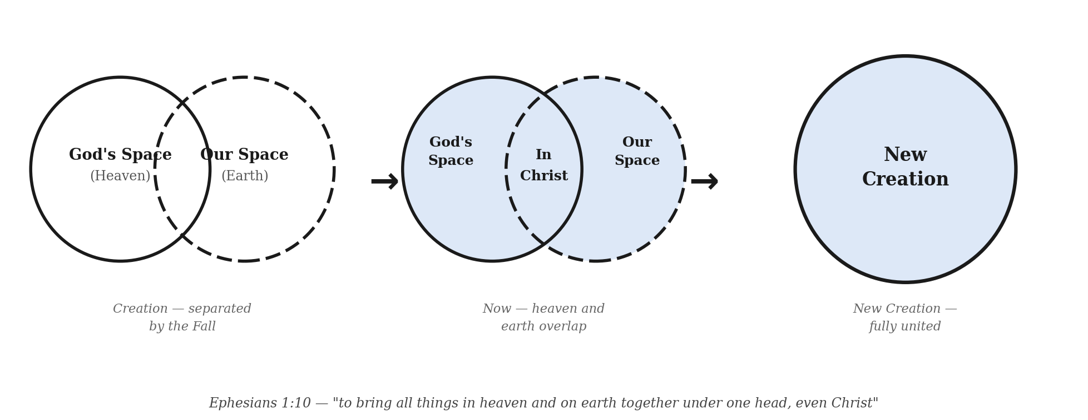
God's two realms — separated by the Fall, overlapping in Christ, and finally united in New Creation
The resurrection of Jesus is the first event of this new creation. A physical, transformed, recognisable body. Jesus was present in real space, eating breakfast on a beach. What Jesus is now, in his resurrection body, is a preview of what the whole creation will be. The final destination is not a disembodied heaven but new heavens and a new earth, with resurrection bodies, in a remade creation where God's presence fills everything.
Revelation 21 makes this concrete. John does not see God's people going up to heaven. He sees the New Jerusalem coming down; heaven arriving here. The direction of travel in the biblical story is not us leaving creation for God's space, but God's space coming to fill and complete creation. That image is vivid, physical, and entirely accessible to children, and it resolves the vague floating picture far more effectively than anything we might invent.
‘I saw the Holy City, the new Jerusalem, coming down out of heaven from God’ - Revelation 21:2
The church as a working model
Ephesians 2:10 adds something that changes how children understand their own community. Paul calls the church God's poiema — his artwork, his poem. The church is not simply a group of people waiting for the future. Tom Wright describes the church as, imperfectly but genuinely, a small working model of what the new creation looks like: formerly divided people becoming one, forgiveness operating, care for neighbour making sense not as a good cause but as a foretaste of what the whole world will become.[3]
Children can hold this. The church is not a club for people who want to go to heaven. It is a community already practising, in small and imperfect ways, what the whole world will look like when Jesus returns. That gives children a reason to be invested in their community rather than just passing time in it.
‘If we are going to be faithful to God, we must ask if our mental map of heaven is grounded in the revelation of Scripture or if it's mostly the product of cultural clichés and sentimental tradition.’
— Skye Jethani, What If Jesus Was Serious About Heaven?
Practical shifts for children's ministry
Reorienting how we teach heaven doesn't require a curriculum overhaul. A few consistent adjustments make the difference over time.
- Define the word when you use it. Rather than letting ‘heaven’ carry its vague cultural baggage, add a brief definition whenever the word comes up: God's space, where he lives and rules, which he is bringing to fill all of creation. Children can absorb this gradually over time if it is consistent.
- Anchor everything to the resurrection. The resurrection of Jesus is not just proof of life after death — it is the prototype of new creation. A physical, transformed, continuous body. When we talk about the future, we talk about it looking like Easter morning, not like floating on clouds. Be clear about what the Bible does —and doesn’t —say when children ask what happens when someone dies. The New Testament is clear that those who die in Christ are with Christ. As Paul writes, ‘to depart and be with Christ, which is better by far’ (Phil 1:23).
While now is not the place for a full exploration of the intermediate state, we can say that this intermediate state is real and matters pastorally. But it is not the final destination. For example, ‘Grandma is with Jesus right now, and one day we will all be together in the new creation God is making’ is both more accurate and richer than ‘She went to heaven forever.’
- Reframe what the church is doing together. When children serve others, practise forgiveness, or care for creation, frame it explicitly: this is what the new creation looks like, and we are practising it now. Present action gains cosmic significance rather than being merely virtuous behaviour.
- Answer the question they actually ask. ‘What will we do in the new creation?’ is a great question. The answer is not ‘float and sing.’ The human vocation from Genesis 1 — tending, building, making, governing creation under God — does not disappear in the new creation; it is restored and completed. Children who understand eternity as the full flowering of what God made humans to be will have a very different posture toward their own lives and gifts now.
The biblical vision of new creation is not complicated. It is a world made right, God present everywhere, humans doing what they were made to do, and the long separation of heaven and earth finally over. Children can understand this — and they may find it considerably more compelling than the alternative.
Further Reading
Skye, J 2023, What If Jesus Was Serious About Heaven? Brazos
Wright, N.T. 2008, Surprised by Hope HarperOne
Wright, N.T. 2025, The Vision of Ephesians Zondervan
Alcorn, R 2004, Heaven Tyndale
Willard, D 1998, The Divine Conspiracy Harper San Francisco
[1] For example, Matthew 6 verse 9: ‘Our Father in heaven (ouranos)’ and verse 26: ‘Look at the birds of the air (ouranos)’
[2] If the phrase ‘government-at-hand’ is unfamiliar, Willard is talking about God's active reign in the present moment, not as a distant future event.
[3] The Vision of Ephesians, Wright, N.T. 2025, The Vision of Ephesians Zondervan