
How to involve teenagers with disability in Youth Ministry
It’s Friday night and youth group is about to start. The chairs are arranged, the tech is all set up with a welcome message on the big screen, and your leaders have prayed and are ready for the teenagers to arrive. Everyone is feeling energised and optimistic about the evening ahead.
Imagine that in your regular group of teenagers there are three people with disability:
· Stacy is a 16-year-old with Cerebral Palsy. She is non-verbal, uses an electric wheelchair to move around, and an iPad to communicate. She fits in well with her peers and contributes quality answers in her discussion group, but it takes some time for her response to be ready. She doesn’t often participate in games or activities, preferring to observe from the sidelines.
· Arthur is 15 years old and is autistic. He has limited verbal communication skills and isn’t always aware of the people around him. He gets very excited to play games and hang out with the leaders and often seems to focus on his personal interests.
· Veronica is 13 and has Downs Syndrome. She has some verbal communication but isn’t always able to understand others or express herself. During the Bible talk and small groups, she usually stands up and starts to walk away, and it takes some effort to encourage her back to the group.
How would you make the night work for everyone present, including these three teens?
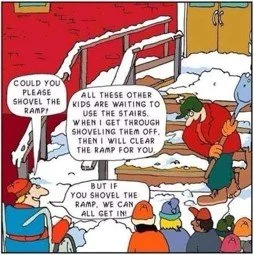
Image credit: © 2002 Michael F. Giangreco. Illustration by Kevin Ruelle. Peytral Publications, Inc.
A good principle to think through during decision making is that if we make something accessible for one person, we have made it accessible for many more, if not all. This image highlights the difference between a ramp and stairs. The stairs present a boundary for some, whereas the ramp enables all people to access the building – including people who we may not have realised have been struggling with using the stairs. Accessible Youth Ministry isn’t simply about making it accessible for those with a disability, it’s about making it accessible for everyone.
Here are four ways to enable young people with disability to meaningfully participate in youth group — as well as in ministries and church services.
1) Ask questions about best support practices
It is best to first ask the teenager what will be most helpful for them to have a positive and meaningful experience at youth group. It’s good to keep the following in mind:
- Some people may need some time to construct an answer, either with thinking time or using a communication device
- Have potential answers to choose from and ask questions like “would you like option A or option B?”
- Continue to check in and ask for feedback, especially if they’re new to the space
Then ask the parents or carers about best practices to help their teenager to participate. A sign-up form may be a helpful way to communicate strengths, challenges, and goals. You might like to ask what support practices happen in school or at home, and to replicate those strategies where possible.
For someone like Stacey, she will know what she wants and needs and she is able to communicate using her iPad. She is just going to need a bit of time to construct her answer as we wait patiently.
2) Interactive learning times
Learning from the Bible can be experiential and hands-on, which makes for longer lasting memories. Some ideas to increase interaction during the Bible talk or small group:
- A re-enactment of the Biblical passages through drama and storytelling
- Recreating the passage through sketching, clay, or creative arts
- Use familiar pictures, emojis, or icons for key word associations as you read along
- Highlight or make key words bold from a passage that are helpful to learn and understand
These ideas might feel like they belong in the kids’ ministry space, but if you implement them well and intentionally, they can be extremely useful for engaging all people in the Bible. So, don’t be apologetic or treat any interactive stuff as something to get through quickly, embrace it and have fun with it!
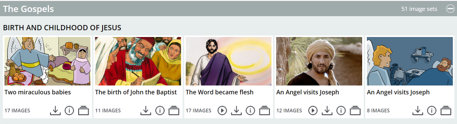
A great resource for Bible images is here: https://www.freebibleimages.org/
For someone like Arthur, re-enacting the passage with his peers and leader encouragement will help him form bonds with his peers, and enable them to think how best to involve everyone in the re-enactment.
3) Adapted participation
Sometimes a person with disability will need extra supports to participate in the different elements of youth ministry. Adapting something will give opportunity for everyone to participate, and for your whole group to appreciate being together and supporting one another.
- Allow extended time for reflection, thinking, or forming an answer
- Send discussion group passages and questions ahead of time for people to read over and prepare before coming to the youth ministry. This will particularly help those with communication devices.
- Turn on the captions for videos
- Change the usual methods of a game or activity so that all people can join in rather than having to sit out. Examples include everyone sitting in seats, working with a partner, or using different equipment.
- Provide resources to choose from, such as large print Bibles and handouts, easy grip writing implements, or fidget tools
For someone like Stacey, she might like to have some answers or questions prepared before she comes to youth group so that she doesn’t risk missing having her voice heard. Emailing the passage and questions that will be asked ahead of time will help her so she can write out some things to contribute and have the Bible passage ready.
4) Meaningful choices
There may be times that a person with disability may not want to participate in the planned activity. This could be due to limitations in ability to participate, an experience of sensory overload, or a fear of failure. Some ways to offer choice within the ministry include:
- During game time or other high energy moments, offer an alternate activity such as a quieter, familiar, and more easy-going game, or a space to sketch and colour. This will also allow for good relational time with leaders and other teens.
- Give options on seating (e.g. floor or chair), location (e.g. outside or inside) or tools and resources to use, and find out what will be most comfortable and conducive to their participation.
- Allow for a young person to ‘tap out’ and move to a break-out space, get some water, or go to the bathroom, just to give them time to self-regulate and prepare themselves to return. Offer a choice between two similar time frames on when to return or for leaders to check back.
It is best to give 2-3 choices rather than an overwhelming selection. Choices help people feel comfortable, give autonomy and will still achieve the desired outcome.
For someone like Veronica, give her choices for how she might like to participate and ways that she can interact with the activity currently happening. She might like to colour or draw during the teaching time, play a quieter game or activity, or be a helper. Using visuals or props will help with communication.
Outcomes
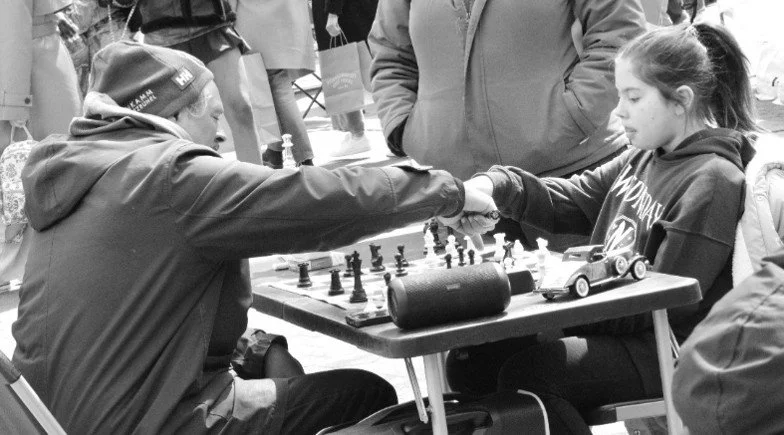
Over time, you’ll find that with consistent communication and trying new ideas, you’ll have more positive interactions and a mutual understanding of the needs of everyone involved in your youth ministry. You will also see a flow-on effect with the rest of the youth group, as all teenagers appreciate the new ideas for themselves and participation for everyone becomes more collaborative. It is an opportunity for the whole community to meet the needs of all people, and to do what it takes to bring people to Jesus.
At the end of gatherings, it is important to debrief, reflect on practices, and pray for the teenagers with disability, the rest of the youth ministry, and yourselves. And pray for the power of the Holy Spirit to be at work in all the teenagers who come along to youth group.
