
Navigating technology
I was surprised to find myself letting out an involuntary groan the other day when someone raised the topic of A.I. Don’t get me wrong, I’m interested in A.I. and the way it is, and will, impact the world we live in, but I’m also tired of hearing both prophets of doom and fortune tellers of optimism deliver their predictions on the so called A.I. revolution. As for almost every topic in our day and age, people very quickly entrench themselves in polarised positions, either vehemently for or against the utility and impact of A.I.
The truth is, technological innovations always come with their benefits and disadvantages. This is an insight that was convincingly demonstrated by Marshall McLuhan in 1962 when he published The Gutenberg Galaxy: The Making of Typographic Man [1]. McLuhan records a history of communication and the effects of communication technologies on human societies. Whilst elucidating the impact of the printing press on human development, McLuhan proposes a tetrad of opposing effects caused by such media which can also be applied to technology more broadly.
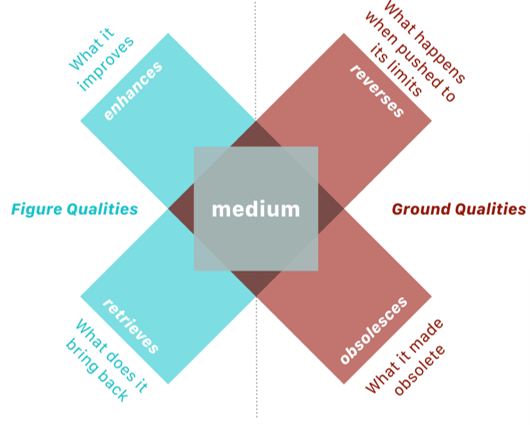
In simple terms, the 4 quadrants of McLuhan’s tetrad ask 4 questions in opposition to each other: ‘What does the medium enhance?’ vs ‘What does the medium make obsolete?’, and ‘What does the medium retrieve?’ vs ‘What does the medium reverse?’ (see the diagram on left). Take the radio for example; it enhances the amplification and availability of music and news, whilst also making obsolete the reliance on visual and print media. Radio retrieves the presence and importance of auditory communication, whilst also reversing our access and ability to communicate via text. For every advantage a technology enables, it also produces an obsolescence or reversal in our human operations.
Perhaps you can see how useful this tetrad is for evaluating any type of technology from smartphones and Facebook to Wi-Fi and motorised vehicles. And maybe you’re ready to have a go at inserting your favourite technology into the tetrad for a thoughtful appraisal, but there are some further questions which we can lay over the top of this tetrad that will help us evaluate technology with a particular Christian lens.
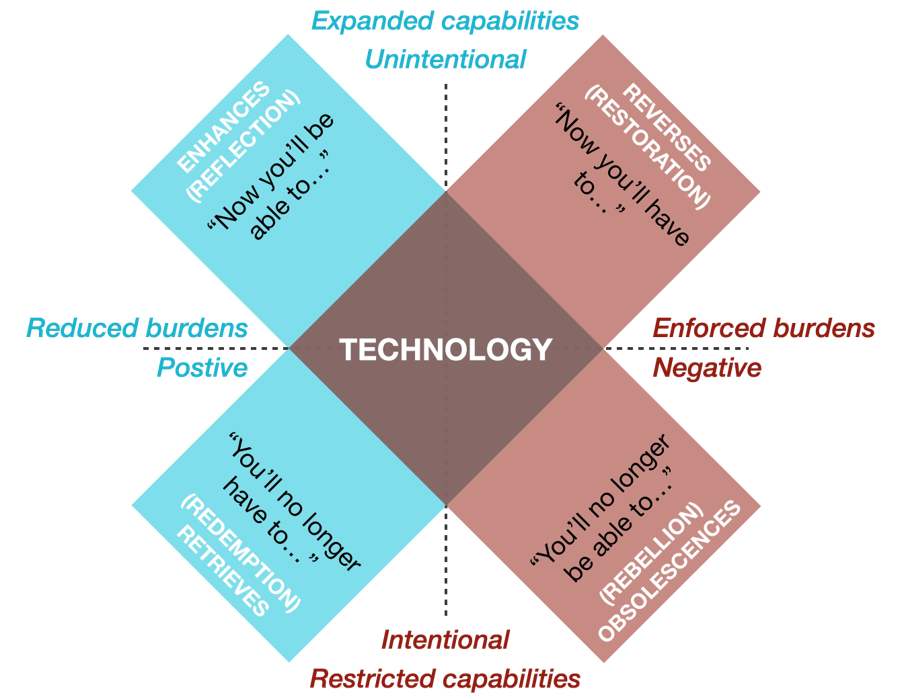
In his 2011 book From the Garden to the City: The Redeeming and Corrupting Power of Technology [2], John Dyer builds upon McLuhan’s tetrad asking questions from biblical-theological categories. To the category of ‘ENHANCING’ he invites us to ask, ‘How does this new technology REFLECT God’s creativity and our creation in God’s image?’ To its opposite category of ‘OBSOLESCENCE’ he invites us to ask, ‘How does this technology express human REBELLION against God’s purpose?’ To the category of ‘RETRIEVAL’ he invites us to ask ‘How can this technology help to REDEEM what has been affected by sin?’ To its opposite category of ‘REVERSAL’ he invites us to ask ‘How does this technology might work against the RESTORATION of God’s creation?’
These kinds of questions help us to evaluate technology with reference to God’s purpose for creation from “the garden to the [heavenly] city”. And this brings us to the decisive question for using this tool (or any tool) in evaluating the usefulness of technology: What is the purpose of all creation?
If you don’t have a clear answer for this foundational question, then it’ll be almost impossible to use this tool and evaluate technologies with any consistency. We need to know what life is about, what life is for, and where life is to be found if we are to appraise the value of new technologies with any success. This is the question that Andy Crouch addresses in his 2022 book The Life We're Looking For: Reclaiming Relationship in a Technological World. Crouch helps us to think about technology by first addressing what it is to be a human creature. After all, exploring the effects of technology on human societies is an anthropological exploration. Crouch makes the biblical case that ‘every human person is a heart-soul-mind-strength complex designed for love.’ That is, designed for love with the creator God, love for one’s neighbour, and love for his creation. This the foundation and purpose of creation.
With clarity about the purpose of creation, what life is for, and what it means to be human, we have a ‘true North’ to guide our steps in evaluating how technologies might both enhance and diminish life, relationship with God, and hope in Jesus. One of the great insights from Crouch is that we refuse to let technology do our work for us. We are not to relate to a technology like a device which uses us, nor are we to use it bluntly like a tool, but we are to use it more like a musical instrument – a piano, guitar, saxophone etc. Using technology like an instrument will take effort, involvement and a considerable effort much like it does to play the violin or the drums. Both the instrument and the musician work with each other to produce harmonious music.
This is much like the way Jesus uses parables in teaching. The parables make you work hard to understand them, they require effort, willingness, and investment, resulting in greater understanding and insight. Relating to technology in any less meaningful or effortless way makes us vulnerable to becoming what Cory Doctorow calls ‘Reverse Centaurs’. [3] That is, rather than technology serving our personhood much like the body of a horse does to the human torso of a centaur, we become the ‘squishy meat appendage’ in service of the inhuman machine. The tail is wagging the dog rather than the dog wagging the tail, so to speak, and this in turn undermines our personhood and God’s intended purpose of creation.
In light of all this, Crouch gives us four clarifying questions that we can add to McLuhan’s Tetrad and Dyer’s biblical-theological expansion. In regard to how a technology facilitates:
• ENHANCEMENT/REFLECTION, we ask: What does this enable us to do?
• OBSOLESCENCE/REBELLION, we ask: What will we no longer be able to do?
• RETRIEVAL/REDEMPTION, we ask: What will we no longer have to do?
• REVERSES/RESTORATION, we ask: What will we now have to do?
For example, the availability of music on Spotify means you’ll be able to listen to an enormous catalogue of music – more than you could ever own. Conversely, you’ll no longer be able to control access to that catalogue or determine what is available (especially if you have a niche taste in music). Likewise, you’ll no longer have to buy albums or CDs or limit your library to what you can physically carry. However, now you’ll need to have internet access and pay a subscription (or put up with ads) for the rest of your life.
All these features come together to give us a biblical-theological way to navigate technology and help our children, young people and their families do the same (see the complete diagram on right). And now we’ve drawn it all together, why don’t you plug in a technology and use this tool to work through an evaluation of how it might both enhance and diminish life as God has intended.
[1] McLuhan, M 1962, The Gutenberg Galaxy: The Making of Typographic Man, University of Toronto Press.
[2] Dyer, J 2011, From the Garden to the City: The Redeeming and Corrupting Power of Technology, Kregel Publications.
[3] Doctorow, C 2026, 'AI Companies Will Fail. We Can Salvage Something from the Wreckage,' The Guardian, 19 January 2026.