
Why Young People Leave the Church (Part 1)
It is heartbreaking to see young people, including members of our own families and churches, walking away from the church. To respond wisely, it is important that we understand when and why they leave.
Research consistently shows that disengagement from church is particularly common during adolescence and young adulthood. According to the 2021 National Church Life Survey, 44% of Australian children from church-attending families were no longer attending church by the age of 30. Church attendance tends to decline between the mid-teen years and age 30, after which attendance patterns become relatively stable.
Recently, I was part of a research project on young church leavers. We examined the data from the 2024/2025 Australian Community Survey to understand when and why they left. Here are some of the key findings:
12.6% of those who leave church do so by age 11.
67.5% leave by age 20.
83% leave by age 30.
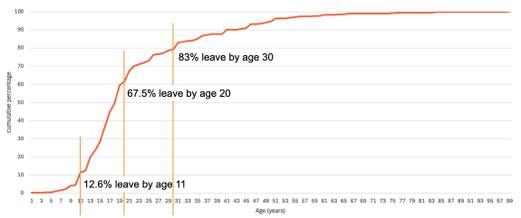
Source: 2024/25 Australian Community Survey
Age when stopped attending frequently: cumulative percentage
While perhaps unsurprising, the results confirm what we already suspect, that the critical ages where young people leave church are in the teenage years, between the ages of 11-20. Youth ministry is therefore vital!
Maybe a more surprising result is the continued drop off between the ages 20 and 30, indicating that young adults are vulnerable too.
That data was cumulative, but the research also reveals the most frequent ages that the participant left - 19, 16, and 11. This suggests that the transitions from primary school to high school, from junior to senior high and from school to university are critical.
After looking at the question of when, we also examined the question of why. The survey included this question and the most common reason given was:
"The process of growing up and making my own decisions" (37%)
Other frequently cited reasons included:
Loss of faith or no longer believing (20%)
Moving to a new area (17%)
Other interests became more important (14%)
Further insights
45% of respondents made additional comments on why they stopped attending religious services, and there was a strong correspondence between the comments and the statistics.
Many respondents talked about the process of growing up, believing that church was a phase that they moved beyond when they got older:
“I stopped attending as I went to a catholic primary school and when I finished primary I stopped going to church.”
Many young people spoke about freedom from their parent’s choices:
“thought it was a waste of time for myself as I felt forced by my parents to attend, when I had no interest in it”
Of those who described a loss of faith, some spoke of their doubts about the veracity of the Christian faith:
“Man made stories of God and religious practices.”
“They pushed me into being transphobic and homophobic and I did not agree”
For others, it was not just an intellectual decision but a moral one, commenting on the suffering in the world or the hypocrisy of the church:
“I looked at the bad things going on in the world, and decided that if there was a god, he/she wasn't worth believing in.”
“disillusioned by court cases against priests/ brothers molesting children”
A few of the participants saw church as a low priority:
“As much as I enjoyed going at Christmas & Easter for communion, it did not take precedence in my life.”
These additional comments illustrate the findings of the statistics, giving us a richer picture of why young people leave.
Implications for ministry
What are some of the implications of this research?
• We were right! The teenage years are the peak time of dropping out of church.
• But between 20-30 years there is a big drop off too, so let’s reconsider the significance of Young Adult ministry.
• Transitions are incredibly important. Do we spend enough time considering how to navigate these in youth ministries? Do we keep in touch with young people when they move house?
• For many young people, leaving church is not a dramatic decision, it is a gradual drift as they grow up or get busy with other priorities. We need to focus on how to keep them connected and engaged.
• Is our teaching engaging with the big questions that young people have, such as suffering, hypocrisy in the church, and views on sexuality and gender?
If all this talk about young people leaving the church is making you feel depressed, remember that young people’s questions are not necessarily the end of faith. The same years in which many disengage are also years of searching, rethinking, and forming identity. The task of the church is not only to prevent departure, but to offer a Christianity that is meaningful, credible, honest, and relationally safe—a faith worth owning for oneself.