
How to bring Bible stories to life for Under 7s
Eric is five. He’s a bundle of energy who loves running and jumping. He barrels out of the church auditorium into the hall for Kids Church like a baby elephant at top speed. How do you get him to settle down and listen to the Bible story?
Engaging preschoolers and children in K-2 can be challenging. They often wiggle, gaze around the room, don’t keep their hands to themselves and generally seem interested in anything but the person up the front. Here are three simple ways to engage these kids well with your Bible stories.
1. Show them something
Give them something to look at to focus their attention right from the start. It could be:
- A picture or a picture with a hidden part (think ‘lift the flap’ type books)
- Something you draw as you speak to them
- An object
- A bag with an object hidden within
- A puppet (even a sock puppet or finger puppet)
- An action or movement you make (eg a salute or throwing an imaginary rock)
It doesn’t need to be particularly impressive or unusual, just something to look at. It’s often helpful to give them a chance to just look and tell you what they see too, even with a simple picture. Putting what they see into words is part of learning for both the one who speaks and all who listen.
2. Repeat the Big Idea
The Big Idea is the main message of your Bible story. It is often about God or Jesus and uses simple age-appropriate language. For example, ‘God always keeps his promises’ or ‘Jesus cares for everyone’. It’s ok to have the same big idea for more than one talk.
Repeating the Big Idea helps young learners to understand and remember. Often with this age group, it can be good to start with the Big Idea, eg, ‘Today we are going to hear a story that reminds us that God always keeps his promises…’. Repeat this during the story and then say it again at the end.
3. Let them move
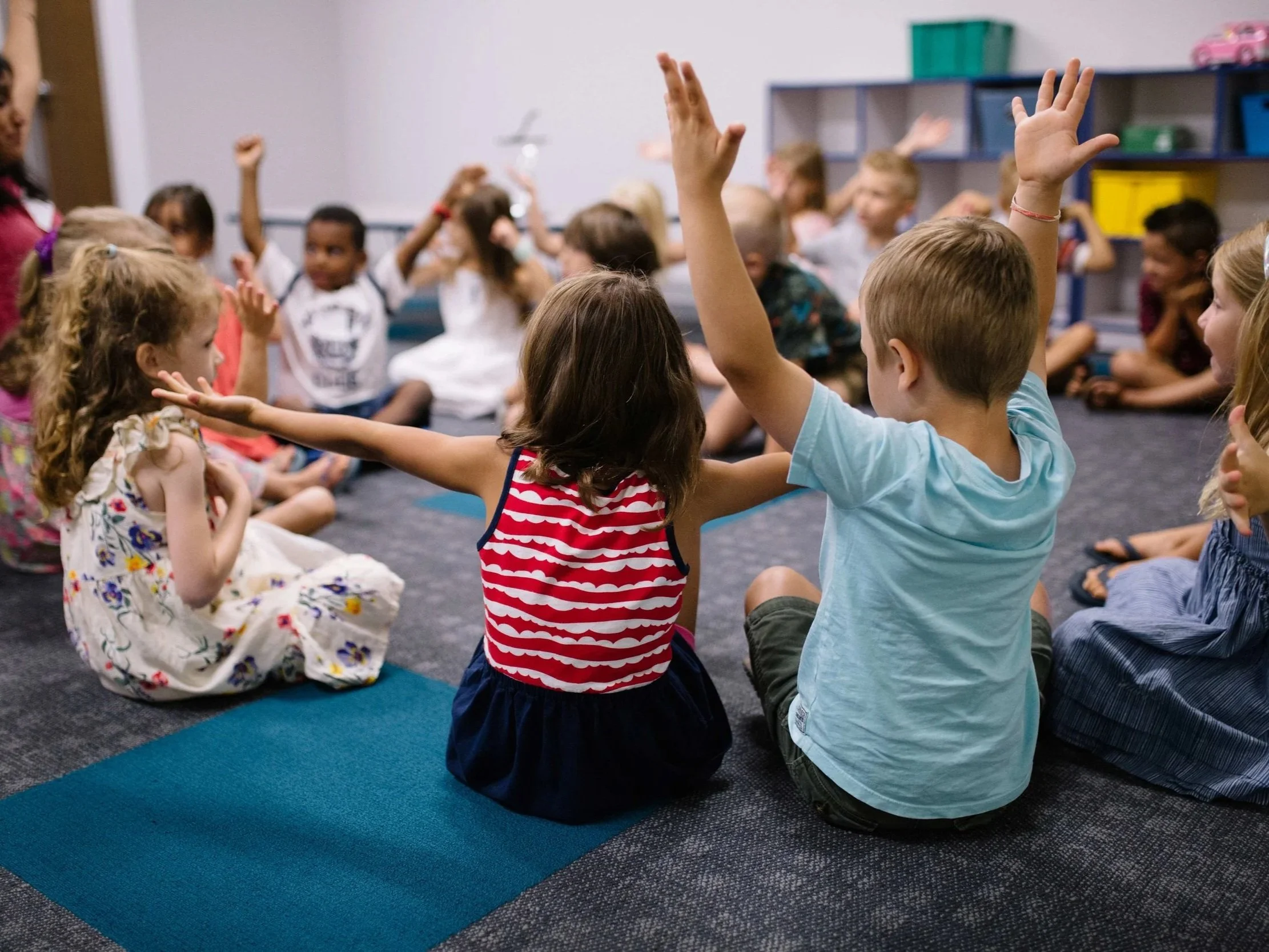
Sitting still is hard, especially for little kids. Give them ways to move that help them stay focused on the story. For this age group, it is best if these are simple and limited, that is, they have a clear end point.
- Ask them to pull a face (eg surprised face, angry face)
- Get them to repeat a phrase (loudly, softly, etc)
- Give them an action to copy (‘Everyone wave goodbye’)
- Show them a hand movement to copy (nothing too complicated, children at this stage are still mastering fine motor skills)
Again, it doesn’t need to be particularly unique. It is simply giving them a meaningful way to move that keeps their focus on the story.
Doing these things won’t mean that kids are riveted to your every word, though some might be. It does mean you are giving them reasons to refocus if they have become distracted.
Here’s what it might look like.
Imagine a group of eight K-2 children with a few preschoolers who’ve snuck in. You’ve welcomed them in to sit on the mat for story time.
“Welcome everyone! Today we’re reading a new story from the Bible (show Bible) that reminds us that God always keeps his promises.”
“Look at this picture I’ve got. What can you see?” (Show picture of the stars or Abram looking at the stars) Listen to some responses and respond with warm encouragements. “In today’s story, God asks someone to count the stars! Could you count them?”
Tell the story of God’s promise to Abraham (Genesis 15), here are some further examples.
“The Lord God said to Abram, ‘Look up at the sky and count the stars’. Can you look up, like Abram? Everyone imagine a sky full of stars.”
“The Lord God told Abram that he would have as many children as all the stars! Wow! That’s so, so many. Can you say, ‘WOW’?” (group repeats ‘Wow’)
It doesn’t need to be complicated or unique, having something to look at, a way to move and a clear big idea will help the group to stay engaged.
Children this age often do take in more than we think they do. If a leader is particularly sensitive to the group, they can become discouraged in seeing children gazing at the ceiling. But keep going anyway, there is no reason to call them out if they are not distracting or hurting others. Sometimes they surprise us and are able to remember more about the story than we expect.
If you’re teaching this age group, it can sometimes feel like nothing is sinking in. But God’s word is powerful, it will not return empty (Isaiah 55:11).
And these children are worth your best efforts.